
Tax-aware Monte Carlo
Tax-aware Monte Carlo for after-tax retirement outcomes
Model simulated retirement paths after the planner applies household taxes, account types, RMDs, and withdrawal assumptions.
A pre-tax Monte Carlo run can hide the timing effects that matter in retirement: taxable withdrawals, RMDs, account placement, and annual tax drag.
Tax-aware Monte Carlo routes each simulated path through saved household, account, and holdings context so the after-tax output is inspectable, not implied.
Workflow screenshots
See the workflow
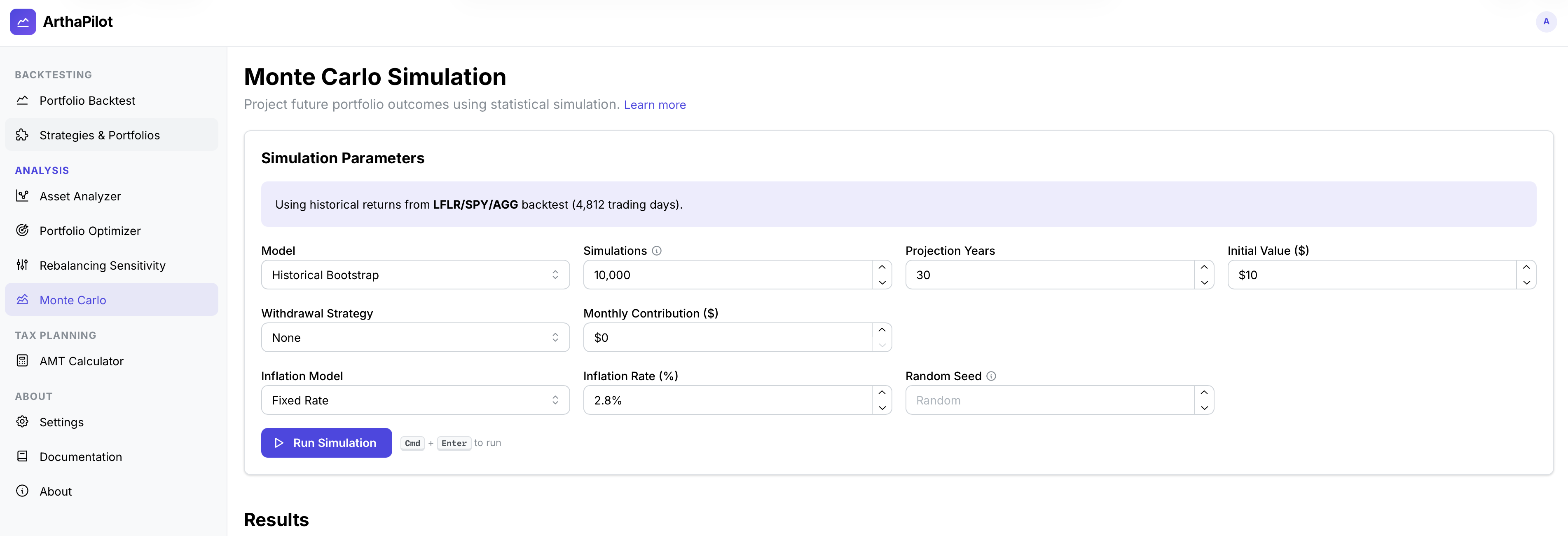
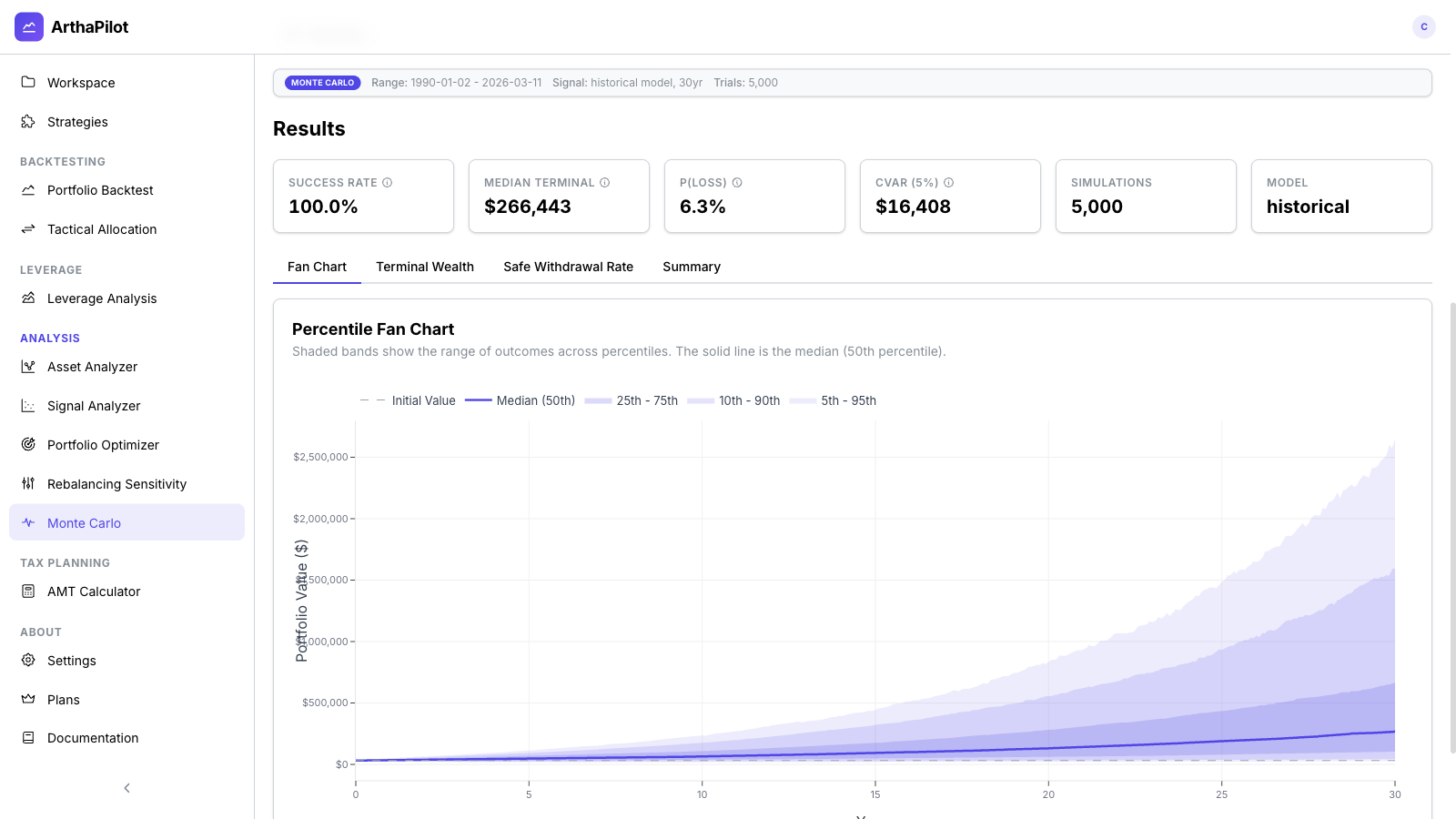
Start with one question
Preview the results
After-tax success range
How does the plan look after the planner applies taxes, RMDs, and account context to each path?
Output previewAfter-tax success rate | terminal value percentiles | lifetime tax paid percentiles
Open retirement example →
Tax-path diagnostics
Which simulated years show tax pressure, RMD effects, or cash-shortfall risk?
Output previewAnnual after-tax fan chart | RMD indicators | cash-shortfall incidence
See Pro plans →
What tax-aware mode adds
- Path-by-path tax calculations using saved household and account context.
- After-tax success rate and terminal value percentiles.
- Lifetime tax paid percentiles and annual after-tax path visualization.
- RMD and cash-shortfall indicators when those events appear in the simulation.
Inputs to inspect before relying on a run
- Household tax profile, filing status, and account tax treatment.
- Holdings snapshot date and whether the snapshot reflects the intended portfolio.
- Return model, withdrawal rule, simulation count, and projection start date.
Current model boundaries
Tax-aware Monte Carlo supports up to 500 paths and a defined set of dynamic withdrawal rules. Read the result as scenario modeling under the disclosed assumptions.
Interpretation boundary
This workflow estimates after-tax paths for configured scenarios. It does not recommend withdrawals, conversions, trades, or filing positions.
FAQ
How is this different from regular Monte Carlo?
Regular Monte Carlo projects portfolio paths before tax effects. Tax-aware mode applies saved household, account, and holdings context to each path. You can then review after-tax success rate, terminal value, and lifetime tax estimates.
Why is tax-aware Monte Carlo Pro-gated?
Each path runs higher-cost account-level tax calculations. The Pro gate covers that heavier compute path and keeps the supported path count bounded.